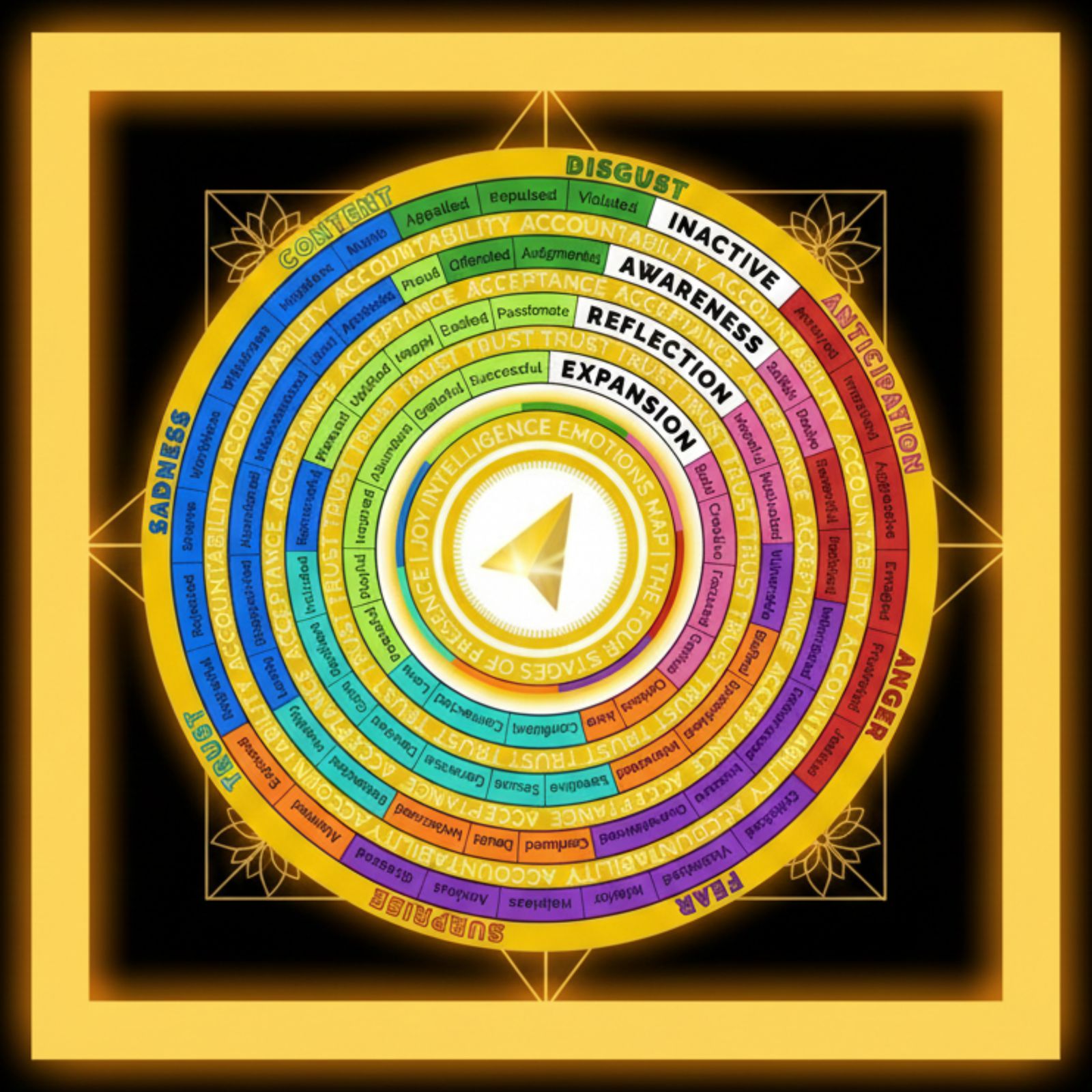
Something remarkable happened in the development of the JOYELY Joy Intelligence (JQ) Emotions Map. As we created this neuroscience-based tool for emotional development, organizing 80 emotions into concentric rings of presence and growth, a pattern emerged. The structure we were building looked familiar. It looked ancient. It looked like the Sri Yantra.
This wasn’t planned. It wasn’t forced. The JQ Map naturally took on the architecture of one of humanity’s oldest sacred diagrams because both are mapping the same fundamental truth about human consciousness. When you’re mapping how awareness actually works, certain patterns appear. The concentric movement from outer reactivity to inner presence. The four-fold foundation that creates stability. The central point where all paths meet. These aren’t arbitrary design choices. They’re the architecture of consciousness itself.
This white paper explores how the JQ Map represents an advancement in our understanding, inspired by wisdom encoded in sacred geometry millennia ago. We’re not discovering something new. We’re remembering something ancient, translating it into the language of modern neuroscience, and making it accessible for everyday life. The ancients mapped consciousness through spiritual practice. We’ve mapped it through brain science. The maps match because the territory is the same.
This alignment has profound implications. It means emotional intelligence isn’t separate from spiritual wisdom. It means ancient practices were describing real phenomena. It means the journey from fear to joy follows universal laws that appear across cultures and centuries. Most importantly, it means we can trust the path. When both ancient mystics and modern neuroscientists arrive at the same map, we can be confident we’re seeing something true about human nature.
For thousands of years, the Sri Yantra has guided spiritual seekers toward enlightenment. This intricate pattern of interlocking triangles, lotus petals, and concentric circles isn’t just beautiful art or religious symbolism. It’s a map. At its center sits the bindu, a single point representing ultimate unity, the cosmic source, the place where all seeking ends in blissful awareness.
The Sri Yantra works like a roadmap of consciousness. It has nine layers, moving from an outer square that represents earthly existence, through circles of lotus petals and geometric patterns, finally arriving at that central point of pure being. Practitioners meditate on this yantra, moving their attention systematically inward. As they do, they’re not just contemplating a pattern. They’re walking a path that countless humans have walked before them, a journey from scattered reactivity toward integrated presence.
Fast forward to 2025. The JOYELY team set out to create a practical tool for emotional intelligence, grounded in what we now know about the brain, the nervous system, and how humans actually process feelings. We studied polyvagal theory, neuroscience research, trauma healing, and decades of psychological insights. We interviewed thousands of people about their emotional experiences. We tested and refined.
What emerged was the JQ Emotions Map: a circular diagram organizing 80 human emotions into four concentric rings representing stages of emotional presence. From the outer ring of survival emotions like terror and rage, moving inward through awareness and reflection, arriving at an inner core of integrated presence. At the center sits a compass, a navigational tool that points in all directions, reminding us that we move continuously through all emotions.
The map gives people a way to locate where they are emotionally, understand what stage they’re in, and see the path forward. It’s practical. It’s grounded in research. It works.
Here’s where it gets interesting. We didn’t start with the Sri Yantra. We started with the brain, with emotions, with what actually helps people grow. But as the JQ Map took shape, the pattern became undeniable. The concentric rings. The movement from outer to inner. The four-fold structure. The central point of unity. We were creating something that looked remarkably like one of humanity’s oldest wisdom diagrams.
This wasn’t coincidence and it wasn’t copying. This was recognition. When you map consciousness honestly, whether through meditation or neuroscience, certain patterns appear because they’re built into how awareness works. The Sri Yantra encoded these patterns in sacred geometry. The JQ Map rediscovered them through scientific study. They match because they’re both mapping the same territory: the human journey from fragmentation to wholeness.
What we’re presenting in this paper isn’t a synthesis or an integration of two different things. It’s the recognition that the JQ Map naturally aligned itself with ancient wisdom because that wisdom was true all along. The Sri Yantra wasn’t metaphor or mythology. It was an accurate map, drawn by people who understood consciousness through direct experience. Modern neuroscience is now confirming what they knew.
This alignment tells us something important: the path is real. Whether someone in ancient India meditating on the Sri Yantra or someone in modern America using the JQ Map in therapy, they’re walking the same ground. The journey from reactive survival to conscious presence isn’t a cultural invention or a psychological theory. It’s the structure of human development itself.
For people doing emotional work, this provides reassurance. You’re not experimenting with untested ideas. You’re following a path that humans have successfully navigated for millennia. The language has changed from “enclosures” and “bindu” to “stages” and “presence,” but the journey hasn’t. Your struggles with anxiety or anger, your work toward emotional balance, your glimpses of joy, these are all part of an ancient, validated process.
For researchers and practitioners, this opens new possibilities. If the pattern is universal, we can learn from both sides. Ancient contemplative practices might accelerate emotional development in ways we haven’t yet explored. Modern neuroscience might explain why certain spiritual techniques work. The boundary between psychological healing and spiritual growth dissolves when we see they’re describing the same transformation.
For our collective wisdom, this matters because it shows that different cultures, using different methods, can arrive at the same truth. In an age of fragmentation and polarization, discovering that mystical geometry and brain science point to the same map of human consciousness is profoundly hopeful. Truth exists. We can find it. And it’s been waiting for us all along.
This paper explores how the JQ Map represents an evolutionary step forward, not by abandoning ancient wisdom but by translating it into accessible, practical, scientifically grounded tools for everyday life. We stand on the shoulders of those who came before, seeing further not because we’re wiser but because we have both their insights and our own.
The symbol we’ve created places the complete JQ Emotions Map within the framework of Sri Yantra sacred geometry. But it’s not a layer cake where we stacked two separate things. It’s more like discovering that a key fits a lock perfectly because they were always meant to go together.
At the heart sits the full JQ Map, unchanged. You can still see all four emotional quadrants displayed in a variety of colors showing the emotional range, open to the interpretation of the user. The concentric rings show the four stages of emotional presence. The 80 emotions are all there. At the very center, the golden compass points in all directions, reminding us that we navigate continuously through all emotional territories. Nothing about the JQ Map has been altered or compromised. It stands complete.
Around this, we’ve added the golden square frame with four gates. This isn’t decoration. The square represents the Sri Yantra’s Bhūpura, the temple boundary that creates sacred space. Each of the four gates opens toward a cardinal direction: north, south, east, west. These gates represent the four entry points to transformation, the four foundational aspects that must be honored for growth to occur.
The color of this golden frame is #EFC100, the exact same color as the JQ Map’s outer boundary. This wasn’t an aesthetic choice. It’s a recognition that they’re the same thing. Both are saying: here is the foundation, here is the structure, here is the container that holds the work of transformation.
If you look closely, you’ll see subtle lotus petals at the corners where the square meets the circle, and faint triangular patterns beneath the map. These hint at the deeper layers of the Sri Yantra, the interlocking energies that the ancient diagram mapped. They’re present but quiet, supporting without overwhelming. The emphasis stays on the JQ Map itself because that’s the practical tool people will use daily.
The whole composition sits on deep black. This isn’t just for visual impact. In both contemplative traditions and neuroscience, the void, the darkness, the space of pure potential is where transformation happens. It’s the stillness required for change. The black makes both the golden frame and the colorful map luminous, emphasizing their importance.
This symbol tells a story. It says that emotional work isn’t separate from spiritual work. It says that the four corners, the four gates, the four-fold foundation matters. You can’t skip any quadrant of emotions and still be whole. You can’t bypass any stage of development and reach true presence. The square holds the circle. The foundation makes the journey possible.
The golden frame creates the stable container, like the four legs of a chair providing support. Within that stability, the circular journey of emotional development can safely unfold. From the outer rings of reactive survival emotions, moving inward through awareness and reflection, arriving at the integrated flow state at the center. It’s the same journey mapped by the Sri Yantra thousands of years ago, now made visible through the language of feelings.
The navigational compass at the center isn’t just symbolic. It represents what makes the JQ Map different from static diagrams. You’re not trying to arrive at some fixed endpoint and stay there forever. The compass reminds you that you’re always moving, always navigating, always choosing. The center provides continuous reminders to check in for safety, presence, and joy as you move through the full range of human emotions. This is about developing the capacity to experience all emotions daily without falling apart, not about escaping to some permanent blissful state.
This symbol works because it wasn’t forced. When we placed the JQ Map within the Sri Yantra framework, everything just fit. The four emotional quadrants aligned with the four gates. The stages of presence matched the inward movement of the yantra. The center point held complementary meanings in both systems. This natural fit tells us something true: we’re not creating something new, we’re revealing something that was always there.
People respond to this symbol because it speaks to something deep. It has the weight of ancient wisdom and the clarity of modern science. It honors where we’ve been and points to where we’re going. It’s a bridge between worlds that were never really separate, just speaking different languages.
For someone doing daily emotional work, this symbol can serve as a meditation focus, a reminder, a map. You can place it where you’ll see it and let it guide your check-ins. Where am I right now? Which quadrant, which stage? Where’s the next gate? What practice would help me move inward? The symbol makes these questions visual and immediate.
For the larger culture, this symbol represents a healing. We’ve spent too long treating science and spirituality as enemies, as if one must be wrong for the other to be right. This symbol says they were always describing the same reality. The mystics mapped consciousness through contemplation. The scientists mapped it through measurement. The maps match. Truth is truth, whether you find it through meditation or through fMRI machines.
Look at the Sri Yantra and you’ll see it immediately: a four-sided square with four gates. Look at the JQ Map and you’ll see it again: four emotional quadrants, four stages of development. This isn’t random design. Four appears because four is the number of foundation, of stability, of manifestation in the physical world.
Think about a chair. Three legs might balance, but they’re always unstable, always seeking equilibrium. Four legs create a stable platform. You can sit without worrying. Four creates the ground from which everything else can rise. This is true geometrically, and it turns out to be true psychologically and spiritually as well.
Across human cultures, four shows up consistently when people map completeness. Four seasons moving through the year. Four elements making up the world. Four cardinal directions orienting us in space. Four chambers of the heart pumping life through the body. When consciousness wants to manifest in the world, it does so through four-fold patterns.
The outermost layer of the Sri Yantra is a square with four T-shaped gates opening toward the cardinal directions. In Tantric tradition, these represent the four doorways into sacred transformation. The east gate symbolizes awakening, new beginnings, the dawn of awareness. The south gate embodies energy and action, the fire of transformation. The west gate offers introspection and reflection, the setting sun of contemplation. The north gate provides wisdom and completion, the stable ground of realization.
This square creates what the tradition calls the Bhūpura, the temple boundary. It’s not trying to keep you out. It’s creating the container within which transformation can safely occur. Just as a temple provides walls that define sacred space, the four-sided square defines the space of consciousness work. Everything that happens in the journey inward happens within this stable foundation.
The Sri Yantra also contains four upward-pointing triangles among its nine interlocking triangles. These represent what the tradition calls Shiva, the masculine principle of consciousness, awareness, and directive will. Four triangles of conscious intention, pointing upward toward aspiration and choice. They interlock with five downward-pointing triangles representing Shakti, the feminine principle of energy and receptivity, but the presence of four specifically signals the stable base of conscious will that enables any transformation to occur.
The JQ Map organizes all human emotions into four primary categories, each occupying a quadrant of the circle. The map uses a variety of colors to display the emotional range across these quadrants, open to the interpretation of the user. Each quadrant holds a family of related emotions.
Here’s the key insight: like the four legs of a chair, all four emotional families must be honored for psychological stability. You can’t eliminate anger and stay balanced. You can’t banish sadness and remain whole. You can’t suppress fear and call yourself healthy. True emotional intelligence isn’t about getting rid of three quadrants and only feeling the pleasant one. It’s about developing the capacity to experience all four, to move through them skillfully, to let each serve its purpose.
When someone tries to be “positive” all the time, cutting off sadness and anger, they’re trying to balance on one chair leg. It doesn’t work. They fall. The emotional system knows it needs all four to function properly. The wisdom traditions knew this too. That’s why the square has four gates, not one. You need all four directions of experience to navigate life successfully.
The JQ Map also delineates four stages of emotional presence moving from outer to inner. Stage one represents the inactive or survival state, where we’re locked in fight-flight-freeze reactivity. Stage two brings awareness, the beginning of noticing and naming what we feel. Stage three offers reflection, the capacity to process and understand our emotional experiences. Stage four opens into expansion, the integrated flow state where we can access our full range without being overwhelmed.
These four stages can’t be skipped. You can’t leap from shutdown straight to flow. Each builds on the previous, creating the foundation for what comes next. It’s exactly parallel to how the Sri Yantra’s layers build from outer to inner. You work through each enclosure before accessing the next. The structure is progressive and cumulative.
Between these four stages sit three crucial barriers. There’s accountability between stages one and two, the gate where we take ownership of our emotional experience instead of staying in blame or numbness. There’s acceptance between stages two and three, where we stop fighting what we discover and start working with it. There’s trust between stages three and four, the final surrender that allows full opening into flow. If we count the arrival at the center as the fourth gate, we complete the four-fold journey: starting in unconsciousness, passing through three transformative thresholds, arriving at integrated presence.
JOYELY teaches four foundational practices that build emotional intelligence, and they map directly onto the four-fold structure:
These four practices, done daily, create the platform from which emotional growth naturally occurs. It’s not complicated. Sit down. Breathe consciously. Notice what you’re thinking. Feel what you’re feeling. Do this consistently and the journey inward begins automatically, just as meditating on the Sri Yantra’s four gates begins the journey toward the bindu.
This pattern of four appears across wisdom traditions because it’s built into how consciousness manifests. Chinese philosophy speaks of heaven and earth creating the four directions, with humans navigating between them. Native American medicine wheels often have four quadrants representing stages of life or aspects of self. Even in fairy tales, there are often four siblings or four tasks or four directions to travel before the treasure is found.
Psychologically, Carl Jung identified four functions of consciousness: thinking, feeling, sensation, and intuition. He noted that developing all four was essential for what he called individuation, the process of becoming a whole person. If you only developed thinking, you’d be unbalanced. If you only valued feeling, incomplete. All four must be integrated.
In neuroscience, we see four-fold patterns in how the brain processes information. The frontal lobes and the limbic system, the left and right hemispheres, creating a four-quadrant model of function. Even the structure of the nervous system, with its sympathetic and parasympathetic branches, each having arousal and calming functions, creates a four-part system that must stay balanced.
In our integrated symbol, the golden square with four gates creates the stable container within which the circular journey of emotional development unfolds. This is the key teaching: you cannot reach the center without honoring all four corners.
You cannot skip the sadness quadrant and arrive at wholeness. You cannot bypass the awareness stage and reach expansion. You cannot ignore your need for boundaries (one of the four gates) while remaining embodied in the world. You cannot access sustainable flow without first establishing the four practices.
The square holds the circle. The foundation enables the journey. Four is the structure through which transformation happens. Not three, which would be unstable. Not five, which would be excessive. Four creates the sufficient and necessary ground.
This is why the golden square frame in our symbol uses color #EFC100, matching the JQ Map’s outer boundary. They’re expressing the same truth in the same color. Before you can spiral inward toward the infinite, you must establish the finite structure that makes the journey possible. Before you can experience the boundless circle of emotional flow, you must honor the bounded square of foundational practices.
The ancient yogis knew this. They created the four-gated square before drawing the lotus petals and triangles inside. They knew that without the container, the energy would dissipate. Modern neuroscience knows this too. Without safety and structure, the nervous system can’t access higher functions. The brain needs the foundation before it can reach for transcendence.
Four isn’t a limiting number. It’s a liberating one. It says: here are the cornerstones. Build on these and everything else becomes possible. Honor these and the journey opens naturally. This is why both the ancient yantra and the modern map begin with four.
Both the Sri Yantra and the JQ Map share the same basic architecture: concentric organization that guides movement from outer edge to inner core. This isn’t a design trend. It’s the structure of how consciousness actually develops.
The Sri Yantra has nine distinct layers, called navāvaraṇa in Sanskrit, meaning “nine enclosures.” You start at the outermost square representing physical reality and material concerns. Then you move through three circles symbolizing the pulls of worldly life, the snares of desire and attachment. Next come the lotus petals, first sixteen then eight, representing the opening of awareness and the stirring of inner energy. After that, you encounter sets of interlocking triangles, each layer addressing different aspects of purification and empowerment. Finally, at the very center, sits the bindu, the dimensionless point of pure consciousness where all the journey concludes in blissful unity.
Each layer is progressively more subtle, more refined, more interior. You’re moving from gross to fine, from material to spiritual, from multiplicity to unity. The practitioner’s attention systematically penetrates inward, peeling away illusions and attachments, until reaching the core of being itself.
The JQ Map follows the same pattern with its four concentric rings. The outermost ring holds Stage 1 emotions like terror, rage, hopelessness, and numbness. These are survival emotions, the most reactive, the most tied to immediate physical threat or overwhelm. Move inward one ring and you find Stage 2 emotions like anxious, frustrated, hurt, and sad. These signal that you’re beginning to notice, to name, to recognize patterns. Another ring inward brings Stage 3 emotions like thoughtful, remorseful, empowered, and understanding. Here you’re processing, meaning-making, transforming. The innermost ring contains Stage 4 emotions like grateful, excited, passionate, creative, and compassionate. These arise when you’re in flow, when presence is established, when safety allows full expression.
At the very center of the JQ Map sits the compass, the navigational arrow. This is similar to the bindu, but with an important difference we’ll explore in depth later. It’s the point where all emotional paths meet, where conscious choice becomes possible, where joy lives as the ground beneath all experience. But instead of being a fixed destination, it’s a dynamic center that continuously orients you as you move through all the emotions of life.
As JOYELY’s research states, “we move inward toward Expansion” and “gain safety, presence, and access to joy in increasing measure.” This is exactly how the Sri Yantra works. The inward movement isn’t arbitrary. It’s how consciousness clarifies, how awareness deepens, how integration happens.
Traditional Sri Vidya practice emphasizes that you cannot skip straight to the bliss of the bindu. You must methodically work through each āvaraṇa, each enclosure, because each represents an aspect of self to be mastered or an insight to be gained. The outer layers deal with grosser attachments like desire for wealth or fear of death. The middle layers address more subtle challenges like ego identification and the last traces of duality. Only after clearing these can you rest in the innermost unity.
This sequential approach recognizes that consciousness transforms in stages. Each layer has its lessons. Try to bypass them and you’ll just encounter them later, often more forcefully. The structure is cumulative and progressive.
The JQ Map teaches the same principle. You identify your current emotional stage and work to move through the barriers to the next. When a stage is avoided or skipped, it reveals where attention is needed. A person in Stage 1 shutdown mode can’t leap directly to Stage 4 flow. First they need to reach Stage 2 awareness by establishing enough safety that their nervous system stops being hijacked by the amygdala. Then they need to pass into Stage 3 reflection by accepting their emotional reality rather than fighting it. Only then can they enter Stage 4 expansion where integration is possible.
This isn’t just psychological theory. It’s neuroscience. A traumatized or highly stressed brain must first regain basic safety through calming the amygdala’s hyperarousal before higher-order prefrontal cortex functions become accessible. You can’t reflect when you’re in fight-or-flight. You can’t access flow when you’re frozen in shutdown. The brain’s own architecture requires this sequential development.
The barriers between stages serve as gates, just like in the Sri Yantra. Accountability is the gate between Inactive and Awareness. You must take ownership of your emotional state rather than staying in blame or numbness. Acceptance is the threshold between Awareness and Reflection. You must stop fighting your feelings and start working with them. Trust is the passage between Reflection and Expansion. You must release the last protective holding and open fully to experience.
These aren’t arbitrary obstacles. They’re natural checkpoints that ensure you’ve integrated the lessons of one stage before attempting the next. Both the ancient spiritual tradition and modern psychology arrived at the same conclusion: transformation can’t be rushed and stages can’t be skipped without consequence.
The Sri Yantra’s most visually striking feature is its nine interlocking triangles: four pointing upward and five pointing downward. These create forty-three smaller triangles when they intersect, all arranged in perfect symmetry around the central bindu. The upward triangles represent Shiva, consciousness, the masculine principle. The downward triangles represent Shakti, energy, the feminine principle. Their interlocking shows that ultimate reality emerges from the balance and union of these complementary forces.
The JQ Map has its own symmetry, though less obvious at first. The circular format allows emotions to be arranged in relationship to each other. The four quadrants create natural balancing. The sadness quadrant sits across from parts of the gladness quadrant. Emotions about protection and boundaries balance with emotions about connection and openness. The progression through stages also represents balancing polarities, moving from purely reactive states through increasing integration until you reach a state where emotional vitality and conscious awareness function as one.
The color progression tells this story too. The outer rings show red and blue shades representing pain, fear, and anger. Moving inward, these transform into yellow and green shades representing growth, joy, and connection. This isn’t about eliminating the challenging emotions. It’s about developing the capacity to work with them skillfully, to let them flow and transform rather than getting stuck.
Both systems use geometric balance to teach psychological and spiritual balance. The eye sees the symmetry and the mind understands: wholeness requires all the parts, all the directions, all the polarities working together.
The Sri Yantra functions as both a map of the cosmos and a map of the individual. Hindu metaphysics understands that the macrocosm and microcosm mirror each other. What’s true for the universe is true for the person. The layers of the yantra correspond to levels of reality, states of consciousness, and stages of spiritual development. Meditating on it guides the mind through the intricate layers of both the cosmos and the self, moving from outer material awareness to inner spiritual core.
The JQ Map works the same way. It externalizes the internal emotional landscape so individuals can navigate it. It process-maps emotions in a way that helps people move from dysregulation to full presence. Modern neuroscience acknowledges that humans experience varying levels or states of consciousness, from reactive survival states to mindful, integrative states, that correlate with brain activity and subjective awareness.
The stages of the JQ Map correspond to distinct patterns of brain function. In Stage 1 survival mode, the amygdala dominates, the prefrontal cortex goes offline, and the person operates in fight-flight-freeze. In Stage 2 awareness, there’s beginning cortical engagement as the person starts to notice and name. In Stage 3 reflection, frontal lobes integrate with the limbic system, enabling processing and meaning-making. In Stage 4 expansion, there’s whole-brain harmony with default mode network integration, creating the flow state.
Each stage is a level of emotional consciousness, not unlike the Sri Yantra’s layers from earthbound to transcendent. Both systems assume consciousness is stratified and that mapping it brings clarity. By knowing where you are in this internal map, you can deliberately progress further.
Both traditions emphasize that transformation is progressive and cumulative. You can’t skip to bliss without doing the work. In Sri Yantra practice, you methodically pass through each enclosure because each represents something to be integrated. The outer layers deal with gross attachments and fears. The inner layers address subtle ego structures and remaining dualities. Only after working through these can you rest in unity.
The JQ Map says the same thing in psychological language. A person in Stage 1 needs to reach Stage 2 by establishing safety and taking accountability. Trying to leap to joy without processing trauma or building regulation capacity doesn’t work. Each stage has developmental tasks that can’t be bypassed.
This matches what neuroscience tells us about how the brain heals and grows. A traumatized brain must first regain safety before higher functions come back online. You can’t access prefrontal integration when the amygdala is in charge. The sequential structure isn’t arbitrary. It’s how healing actually happens.
Both the Sri Yantra and JQ Map aim to produce greater clarity, balance, and well-being. Engaging with the Sri Yantra brings inner peace, harmony with cosmic order, clarity of insight, and balance of mind. By meditating on its balanced form, the practitioner aligns with harmony, achieving clarity and moving from complexity toward unity.
The JQ Map’s purpose is comparably therapeutic. It turns emotional overwhelm into grounded clarity. It helps users name feelings and gain understanding. It builds emotional regulation and resilience. It achieves balance in the nervous system and brain.
Research shows that putting feelings into words dampens amygdala reactivity and engages the prefrontal cortex, facilitating calmer processing. The map provides structured language with 80 defined emotions to do exactly this. Both systems emphasize balance as the key to well-being.
The Sri Yantra’s bindu represents the ultimate destination. It’s the seat of the Divine, the cosmic source, the point where all duality dissolves. Reaching it means attaining samadhi, the highest consciousness, blissful unity with the absolute. The bindu is dimensionless, beyond space and time, both the alpha and omega. It’s both the origin point from which creation emanates and the return point to which consciousness flows.
The center of the JQ Map serves a different but complementary function. At the heart sits a compass, a navigational arrow that points in all directions. This isn’t a fixed destination where you arrive and stay forever. It’s a reminder that you’re always moving, always navigating, always choosing your way through the emotional landscape.
This is a crucial insight about emotional intelligence: it’s not about reaching some permanent blissful state and staying there. Life doesn’t work that way. Challenges come. Loss happens. Anger arises when boundaries are violated. Sadness arrives when we lose what matters. These emotions aren’t failures. They’re part of being fully human.
The compass represents the capacity to move through all emotions without falling apart. It’s about developing the skill to navigate the entire map, visiting all four quadrants as life requires, accessing all the emotional richness that makes us human, while maintaining a stable center of presence.
In the JOYELY framework, joy isn’t the pinnacle emotion you’re trying to reach instead of all others. Joy is the emotion underneath all emotions. It’s “a resonant state of positive emotional energy characterized by meaning, connection, and vitality,” but more importantly, it’s “a kind of resilient joy that underlies whatever emotion we are feeling.”
This is profound. Even when you feel sadness or anger on the surface, that baseline joy remains accessible underneath. It’s the ground of being, not the only emotion you’re allowed to experience. Think of it like the golden color of the square frame in our symbol. It’s there constantly, providing the foundation, even when you’re working with the blues and reds and purples of active emotions.
This aligns with the bindu in a beautiful way. The bindu represents the unchanging reality beneath all changing phenomena. Joy, in the JQ Map, is the unchanging presence beneath all changing emotions. Both are saying: there’s a stable core that remains even as the surface experiences shift.
The difference is that the navigational compass emphasizes movement rather than arrival. You’re not trying to escape the emotional landscape into some transcendent state. You’re learning to navigate it skillfully, to access the full range of human feeling, while staying connected to that underlying joy.
Here’s the key insight: safety needs to be present so we can feel safe and access and remember our joy, even during life’s ups and downs. Without safety, the nervous system stays locked in survival mode. The amygdala remains hypervigilant. We can’t access joy or presence or the higher stages of emotional development because our neurobiology is focused on threat.
Safety isn’t the absence of challenge. It’s the internal sense that “I can handle what comes.” It’s the confidence that “I have resources to navigate difficulty.” It’s the embodied knowing that “I’m not alone in this.” When that safety is established, through practice and through secure relationships, joy becomes accessible even when things are hard.
This is why JOYELY emphasizes being “Rooted in Safety” and “Powered by Presence.” The foundation must be solid before the exploration can happen. But once that foundation is there, you can move through the entire emotional spectrum without losing your center.
The navigational compass at the center of the JQ Map provides continuous reminders to check in for safety, presence, and joy. This isn’t a one-time meditation. It’s a daily practice, multiple times a day, of pausing to ask:
These check-ins become the rhythm of emotional intelligence. They’re how you develop the capacity to experience all emotions daily without falling apart. You’re not trying to control which emotions arise. You’re developing the skill to notice them, understand them, work with them, and stay connected to your center even as they move through you.
The compass reminds you that this is an ongoing journey, not a destination. Every day brings new emotions. Every challenge invites you to navigate again. Every joy offers practice in gratitude and openness. The work never ends, but that’s not a problem. That’s life. The compass keeps you oriented as you move through it all.
Instead of saying the JQ Map “aligns emotional experience with core presence,” it’s more accurate to say: the JQ Map aligns each individual with experiencing a fuller range of emotions daily without falling apart.
This is the real goal. Not to feel only positive emotions. Not to eliminate anger or sadness. Not to escape into some blissful void. But to develop the capacity to feel everything, to let emotions flow as they need to, to access the full spectrum of human experience, while maintaining your center.
When you can feel grief without being destroyed by it, that’s emotional intelligence. When you can feel rage without acting destructively, that’s growth. When you can feel joy without grasping at it desperately, that’s presence. The navigational compass reminds you that you’re developing this capacity, this range, this fullness of being human.
The center holds. The compass points. You navigate. And underneath it all, that resilient joy remains, not as a goal to achieve but as a ground you’re learning to trust.
While the Sri Yantra has nine layers and the JQ Map has four stages, they’re describing the same territory at different scales. Think of it like different map resolutions. The Sri Yantra provides fine detail with nine distinct enclosures. The JQ Map offers a broader view with four main stages. Both are valid. Both are useful. They complement each other.
Here’s how they align:
The outermost square of the Sri Yantra, called the Bhūpura, represents earthly existence and material concerns. This is the starting point, the realm of physical reality, the boundary between ordinary consciousness and the sacred journey. It corresponds to Stage 1 of the JQ Map, the inactive or survival state. Both represent being locked in basic, material, reactive patterns. Both are the foundation from which growth must begin.
Moving inward, the Sri Yantra presents three circles representing the three worlds, the pulls of desire, knowledge, and action that enchant us and keep us bound. This maps to the later part of Stage 1 and the transition to Stage 2. These are the automatic loops of reactivity, the patterns driven by unconscious needs and fears. Breaking free requires beginning to witness them rather than being completely identified with them.
Next come the sixteen-petal and eight-petal lotus layers of the Sri Yantra, representing the opening of awareness and the stirring of inner energies. These correspond to Stage 2, where awareness blooms like a lotus. You begin noticing, naming, recognizing patterns. Presence starts to increase. It’s the beginning of real change.
The sets of interlocking triangles in the Sri Yantra deal with purification, empowerment, removing negativity, and accomplishing purposes. These map to Stage 3, where deep processing and transformation occur. You’re cutting through old patterns, understanding roots of behavior, forgiving and releasing. The work is active and conscious here.
The innermost triangle of the Sri Yantra grants all achievements and houses the goddess. This corresponds to Stage 4, where you’ve reached integrated flow. You’re operating at full capacity. All your resources are online. You’re experiencing what positive psychology calls flourishing.
Finally, the bindu and the compass both represent the center. The bindu as the point of absolute unity and bliss. The compass as the navigational tool that keeps you connected to underlying joy while you move through all emotions. Both are saying: here is the core, the ground, the place all paths lead.
What makes this correspondence more than just abstract theory is that people actually walk this path. Someone struggling with trauma starts in Stage 1, feeling terror or rage or numbness. Through therapy or practice or both, they gradually establish enough safety to move into Stage 2. They start naming their feelings, noticing patterns. Then they move into Stage 3, doing the deep work of processing memories, reframing narratives, finding meaning. Eventually they reach Stage 4, where they can access flow and joy and creativity, while still honoring all emotions as they arise.
This isn’t a straight line. It’s a spiral. You might reach Stage 4 in one area of life while still being in Stage 1 in another. New traumas or challenges can move you back to earlier stages temporarily. But each time through, you know the territory better. The path becomes familiar. The gates become easier to recognize and pass through.
The same is true for Sri Yantra practice. You might meditate on the yantra for years, making progress and then encountering new layers of ego or attachment that need clearing. The journey spirals inward, each circuit bringing you closer to the center while revealing more work to be done. But the work is the path. The process is the point.
Using both maps together enriches the journey. The Sri Yantra provides the spiritual context, the reminder that this work connects you to thousands of years of human wisdom, that you’re not alone in this struggle, that the path is real and validated. The JQ Map provides the practical tool, the daily language of emotions, the neuroscience-grounded understanding of how your brain is actually changing.
You might meditate on the Sri Yantra in the morning, letting your attention rest on its sacred geometry, reminding yourself of the journey toward unity. Then throughout the day, you use the JQ Map for emotional check-ins, locating yourself, noticing which stage you’re in, practicing the skills appropriate to that stage.
The two approaches support each other. The spiritual dimension gives meaning and inspiration to the daily work. The practical dimension makes the spiritual wisdom accessible and applicable. Together, they create a complete path from wherever you are now toward the wholeness you’re seeking.
Use the integrated symbol as a meditation focus each morning. Spend five minutes gazing at it, letting your attention move from the golden square through the emotional quadrants toward the center compass. Ask yourself: where am I starting today? Which emotions are present? Which stage am I in? What do I need?
Throughout the day, do emotional check-ins using the JQ Map. When you notice a strong feeling, pause. Name it. Locate it on the map. What quadrant? What stage? This simple practice of locating and naming activates your prefrontal cortex and begins shifting you from reactive to responsive.
Practice the four foundations daily: Sit (ground yourself physically), Breathe (regulate your nervous system), Think (notice your thoughts with awareness), Feel (allow emotions to be present without fighting them). These four practices create the container that makes all other growth possible.
Before sleep, reflect on the day’s emotional journey. Which quadrants did you visit? Which stages did you move through? Did you honor all four directions of experience, or did you avoid some emotions? Can you feel the underlying joy even if the day was challenging?
Present the JQ Map to clients as both a practical tool and a sacred diagram. Explain that this isn’t just modern psychology but aligns with ancient wisdom about how consciousness develops. This framing can help clients see their struggles as part of a universal human journey rather than personal failures.
Use the map to normalize all emotions. Show clients that all emotions have their place on the map. They’re not emotions to eliminate but to honor and work with skillfully. The goal isn’t to stay in only the pleasant quadrants all the time. It’s to develop capacity for the full range.
Help clients identify which stage they’re typically in and what barrier lies ahead. Someone stuck in Stage 1 needs safety-building work. Someone in Stage 2 needs acceptance. Someone in Stage 3 needs to practice trust. Knowing which gate is next helps focus the therapeutic work.
Use the four-fold structure to assess balance. Is the client honoring all four emotional quadrants or suppressing some? Are they practicing all four foundations (sit, breathe, think, feel) or neglecting some? Where’s the imbalance? Address that first.
Introduce the JQ Map in workplace emotional intelligence training. Frame it as a leadership tool for understanding team dynamics. Leaders who can recognize which stage team members are in can respond appropriately. Someone in Stage 1 crisis needs safety, not problem-solving. Someone in Stage 3 needs space for reflection, not pressure for quick decisions.
Create a culture where all emotions are welcome. Use the language of the four quadrants to make it normal to discuss the full range of emotions at work. “I’m feeling strongly about that decision today” becomes an acceptable way to communicate. This builds psychological safety.
Place the integrated symbol in common spaces as a reminder. Let it serve as a conversation starter about emotional awareness and the importance of honoring all aspects of human experience in the workplace.
Measure organizational health using the stages. A healthy organization has most people in Stages 3-4 most of the time, able to reflect and expand. An unhealthy organization has many people stuck in Stage 1 survival mode. Use the map to diagnose and intervene.
Study whether teaching clients about the map accelerates therapy outcomes. Does understanding the stages and gates help people progress faster? Does the sacred geometry framing increase motivation or meaning?
Investigate the neural correlates of each stage. Can we map specific brain activation patterns to the four stages? Do the barriers between stages correspond to measurable shifts in neural integration?
Explore cross-cultural applications. Do these patterns hold across different cultural contexts? How do other wisdom traditions map consciousness development? Can we find universal patterns beneath cultural variations?
Research the effectiveness of combining ancient contemplative practices (like Sri Yantra meditation) with modern emotional intelligence training. Does the combination produce better outcomes than either approach alone?
This exploration has revealed something both ancient and new. The JQ Map, created through rigorous neuroscience research and practical application, naturally aligned itself with the Sri Yantra’s sacred geometry. Not because we copied it. Not because we synthesized two different things. But because both are mapping the same territory: the actual structure of human consciousness development.
When the ancient yogis sat in meditation and mapped their inner journeys, they discovered real patterns. The concentric movement from reactive to integrated. The four-fold foundation that creates stability. The progressive stages that can’t be skipped. The central point of unity that underlies all experience. These weren’t religious beliefs or cultural inventions. They were observations of how consciousness actually works.
When modern neuroscientists study the brain, emotional regulation, and trauma healing, they discover the same patterns. The staged development from amygdala-driven reactivity to prefrontal integration. The importance of safety as foundation. The necessity of sequential healing. The flow state where all brain regions work together harmoniously. These aren’t just theories. They’re measurable realities.
The maps match because the territory is the same. Human consciousness develops according to natural laws, whether those laws are described in spiritual or scientific language. The JQ Map represents advancement, but not abandonment. We’re moving forward by standing on the shoulders of those who came before, seeing further because we have both their wisdom and our own tools.
We live in a time of unprecedented stress, fragmentation, and disconnection. Mental health challenges are epidemic. People feel lost, anxious, overwhelmed. Traditional institutions and beliefs no longer provide the guidance they once did. Many search for meaning but don’t know where to look.
The alignment between ancient wisdom and modern science offers a path forward. It says: you’re not making this up. The journey from fear to joy is real. The stages are mappable. The path is validated by both spiritual traditions and neuroscience. You can trust it.
For those who find meaning in spirituality, the JQ Map shows that their practices aren’t outdated superstition. They’re working with real patterns of consciousness that science now confirms. For those who trust science but hunger for meaning, the Sri Yantra shows that spiritual wisdom was onto something true. The boundary between these worlds dissolves when we see they’re describing the same reality.
This matters practically too. The JQ Map gives people a tool they can use today, right now, to navigate their emotional lives. No special training required. No need to retreat to a monastery. Just a map, some practices, and the willingness to do the work. But knowing that this work connects them to an ancient lineage, that they’re walking a path validated by millennia of human experience, provides the motivation and inspiration to continue when it gets hard.
Wisdom traditions stay alive not by freezing in the past but by evolving while maintaining their core truths. The Sri Yantra has been reinterpreted countless times across centuries, applied in different cultural contexts, translated into various practices. It remains powerful because its core insight is true: consciousness develops in stages from fragmentation to wholeness.
The JQ Map represents the next evolution of this tradition. We’re taking the pattern and making it accessible in contemporary language, grounded in modern science, applicable to daily life. We’re not claiming to have invented something new. We’re claiming to have recognized something eternal and found a way to share it more widely.
This is how wisdom advances. Each generation receives the teachings, tests them in lived experience, translates them into current understanding, and passes them forward. The yogis passed the Sri Yantra forward. We’re receiving it, recognizing its truth in our neuroscience research, and passing it forward as the JQ Map. Future generations will do the same, finding new languages and applications while the core pattern remains.
This paper isn’t just academic analysis. It’s an invitation to walk the path. Whether you’re drawn to the ancient sacred geometry or the modern emotion map, whether you prefer meditation or therapy, whether you speak the language of chakras or neural networks, you’re invited into the same journey.
Locate yourself on the map. Where are you right now? Which emotional quadrant, which stage of presence? Look honestly. This is your starting point.
Honor the four foundations. Sit, breathe, think, feel. Do these daily. They create the container for everything else.
Work with all four emotional quadrants. Don’t try to eliminate anger or sadness. Learn to navigate them skillfully. Wholeness requires all the parts.
Move through the stages progressively. Don’t skip the hard work. Each barrier exists for a reason. Pass through it consciously.
Trust the underlying joy. Even when life is difficult, even when you’re feeling challenging emotions, that ground of joy remains. Learn to access it, remember it, return to it.
Keep the compass visible. Remind yourself daily that you’re navigating, not stuck. Movement is always possible. The center always holds.
Both the Sri Yantra and the JQ Map make the same promise: this journey is worth taking. Yes, it’s challenging. Yes, it requires dedication. Yes, you’ll encounter barriers and difficulties. But on the other side lies something real. Integration. Wholeness. The capacity to live fully, feeling everything, without falling apart. The joy that underlies all experience. The presence that transforms ordinary life into something sacred.
Thousands of years of human wisdom say this is possible. Modern neuroscience confirms it’s achievable. Countless individuals have walked this path successfully. The map is clear. The practices are available. The support exists.
All that’s needed is the willingness to begin, right where you are, with whatever emotions are present today. The square holds the circle. The foundation supports the journey. The compass points the way.
The path is real. The destination is certain. And you’re already on your way.
Bhavanopanishad & Traditional Sri Vidya Commentary. Meaning and symbolism of Nava Avarana of Shri Chakra. Explains each enclosure’s significance in terms of elements, senses, energies, and states of consciousness.
Maha Vidya Sadhana Center (2023). “The Significance of the Sri Yantra in Srividya Sadhana.” Describes the Sri Yantra’s role as a map of spiritual ascent and its nine layers from Bhūpura to Bindu.
JOYELY, Inc. (2025). Joy Intelligence (JQ) Whitepaper: A Neuroscience-Based Model for Early Emotional Development. Introduces the Four Stages of Emotional Presence and the JQ Emotions Map.
JOYELY Research Team (2025). The Neurobiology of Emotional Presence. Explains how safety and presence enable higher emotional stages and the role of joy as underlying emotion.
Lieberman, M.D. et al. (2007). “Putting feelings into words: affect labeling disrupts amygdala activity.” Psychological Science, 18(5):421-428.
Porges, S.W. (2011). The Polyvagal Theory: Neurophysiological Foundations of Emotions. Norton.
Siegel, D.J. (2012). The Developing Mind: How Relationships and the Brain Interact to Shape Who We Are. Guilford Press.
Fredrickson, B.L. (2001). “The broaden-and-build theory of positive emotions.” American Psychologist, 56(3):218-226.
Plutchik, R. (1980). Emotion: Theory, research, and experience, Vol.1. Academic Press.
Ekman, P. (2003). Emotions Revealed. Times Books.
Jung, C.G. (1963). Memories, Dreams, Reflections / Collected Works vol. 9i. Princeton University Press.
Jung, C.G. (1968). Psychology and Alchemy. Princeton University Press.
Lawlor, R. (1982). Sacred Geometry: Philosophy and Practice. Thames & Hudson.
Schneider, M.S. (1994). A Beginner’s Guide to Constructing the Universe. Harper Perennial.
Document Information:
Acknowledgments: This work honors the countless practitioners and teachers who have mapped consciousness across millennia, from ancient rishis to modern neuroscientists, and the JOYELY team creating practical tools for everyday transformation.
“The mandala is the center. It is the path to the center, to individuation.” (Carl Jung)
“Joy is not just an outcome but a background presence, a kind of resilient joy that underlies whatever emotion we are feeling.” (JOYELY)
“The bindu is Sarvānandamaya, full of all bliss, the abode where all seeking ends.” (Sri Yantra tradition)
These truths speak the same language, pointing to the same reality.
JOYELY® transforms workplace culture with digital emotional processing tools and data-driven technology, empowering engaged, resilient, and high-performing teams. Dedicated to elevating global well-being, JOYELY® makes joy a core life skill through experiences like the Chair of JOY®, JOY Intelligence™ Emotions Map, and the Four Stages of Presence. Inspiring individuals and organizations to access clarity, resilience, and purpose, JOYELY® is available for conferences, keynotes, event showcases, interactive programs, and fundraising—creating an undeniable conversation for all.

Welcome to JOYELY, where JOYELY Ever After is not just a dream, it’s our lifestyle.
© 2025 JOYELY. All Rights Reserved.
