About/Emotions Map
JQ Emotions Map™

From naming an emotion to moving through it.

Two maps, one framework: 60 emotions for children, 80 for adults.

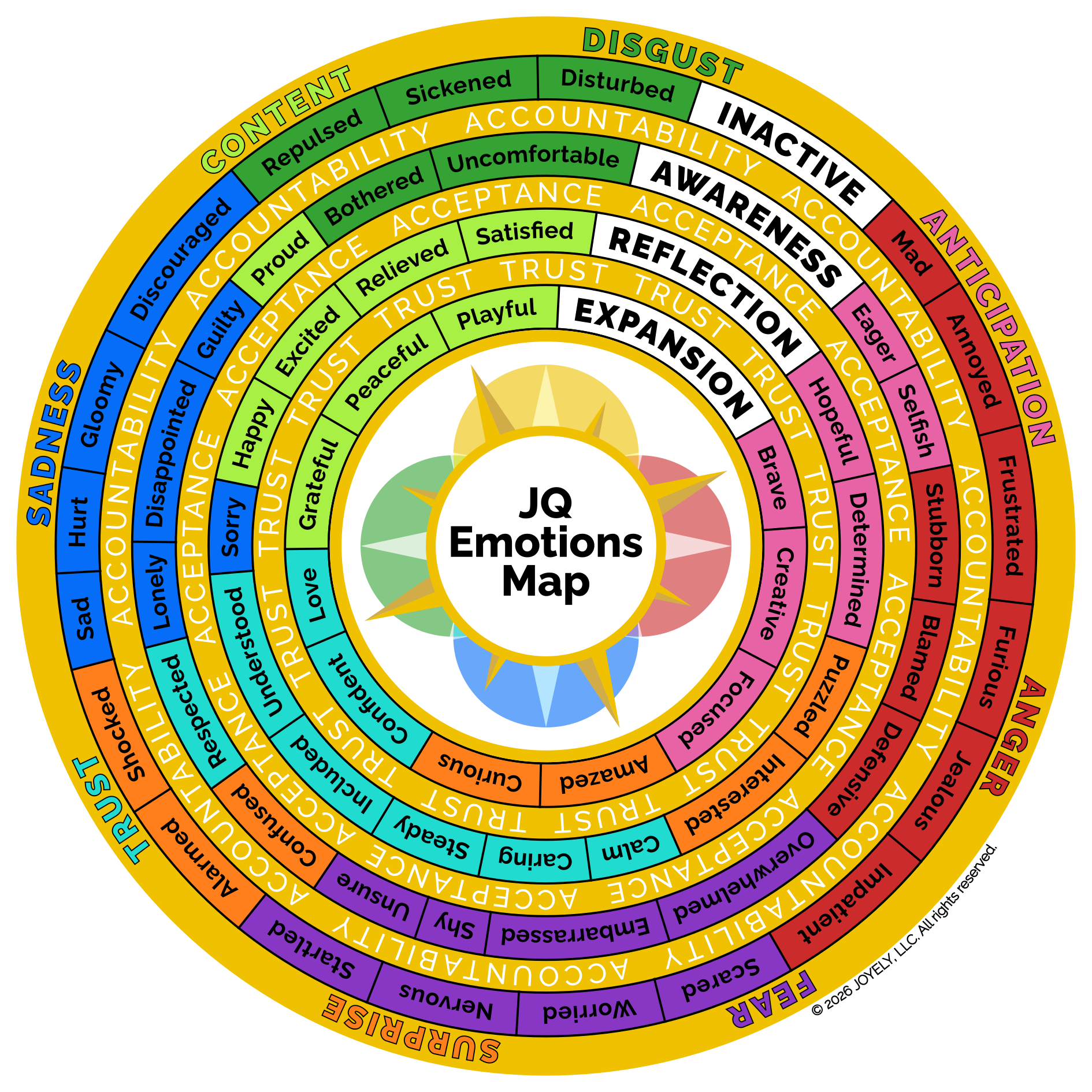
JQ Emotions Map™ for children: 60 emotions across four stages of presence
Children's Map · 60

Concrete and age-appropriate.

60 emotions in simple, everyday words children already know. Same structure as the Adult Map.

Road map: Name · Process · Navigate
Stage → barrier to cross
  1. Inactive→ Accountability
  2. Awareness→ Acceptance
  3. Reflection→ Trust
  4. Expansion
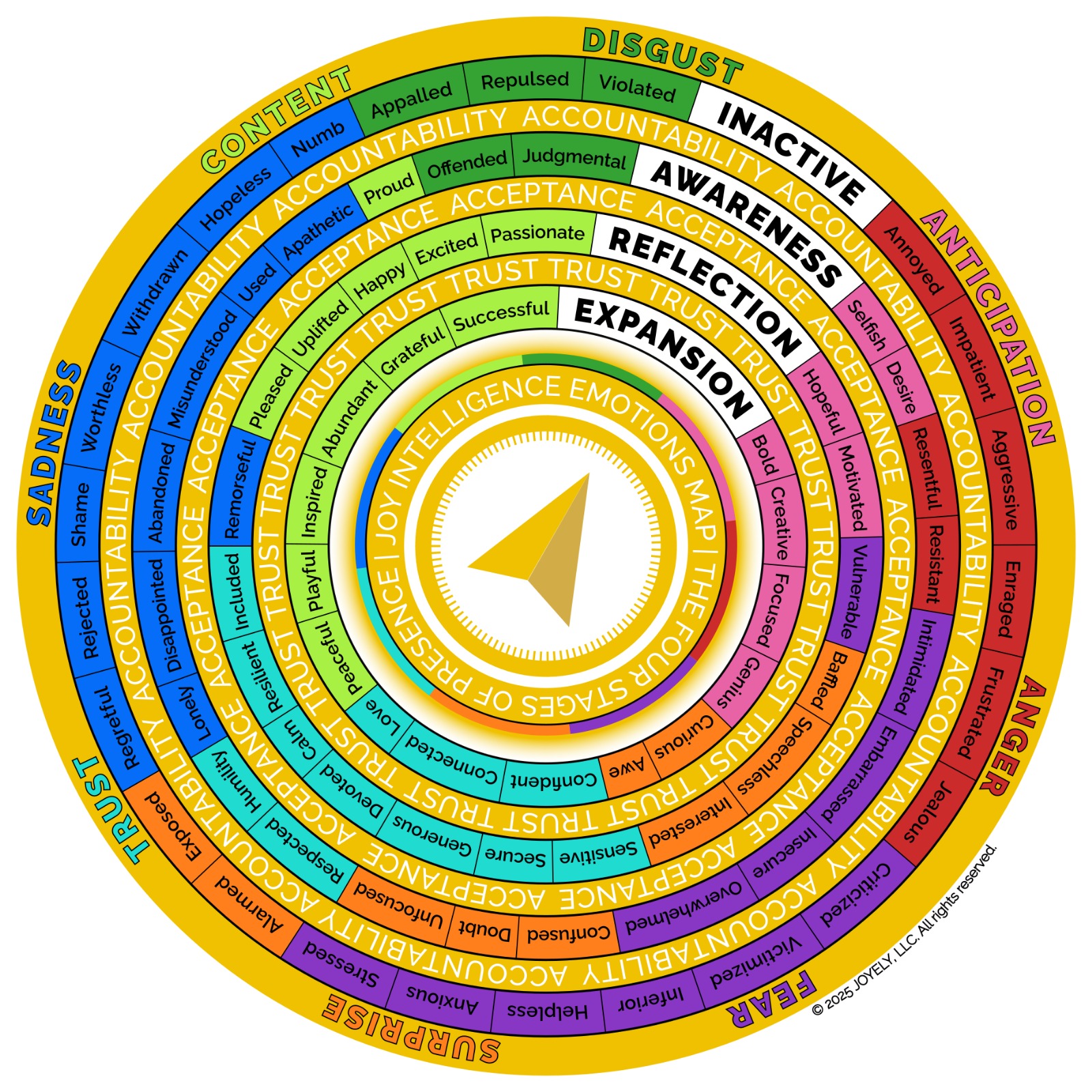
JQ Emotions Map™ for adults: 80 emotions across four stages of presence
Adult Map · 80

Nuanced and layered.

80 emotions, including complex ones adults experience. Same structure as the Children's Map.

Road map: Name · Process · Navigate
Stage → barrier to cross
  1. Inactive→ Accountability
  2. Awareness→ Acceptance
  3. Reflection→ Trust
  4. Expansion
The Maps

One framework. A universal language.

A new way to live each day: build your emotional vocabulary to regulate and navigate emotions, so that you can:

  • Name emotions precisely
  • Decide with awareness
  • Navigate through overwhelm
  • Locate your stage
  • Cross emotional barriers
  • Connect without judgment
  • Feel alive again
  • Build your baseline

What sets this model apart

Traditional models judge emotions as good or bad (valence) and high or low energy (arousal). The SPJ Model reads three independent, value-neutral dimensions. Joy sits beneath every emotion and is always available to us; raising our awareness of Safety and Presence lifts the baseline and makes Joy easier to access.

S

Safety

Am I protected enough to be authentic?

P

Presence

How much usable attention do I have right now?

J

Joy

Am I connected to meaning, purpose or love?

How It Differs

Compared with established models.

Patent pending: Integrated Valence Theory (SPJ Model)

Most models rate emotions on valence and arousal: pleasant or unpleasant, high or low energy. The SPJ Model replaces that single good-bad axis with Safety, Presence and Joy, and the map adds a path for moving forward.

  Plutchik's WheelPlutchik, 1980 Atlas of EmotionsEkman, 2016 Mood MeterYale RULER JQ Emotions Map™JOYELY
Organized by 8 primary emotions, intensity, blends 5 universal emotions and their states Valence and arousal (pleasantness, energy) 8 emotion families × 4 stages of presence
Purpose Classify emotions Understand triggers and responses Identify a current state Locate a state, then shift it
Change over time Not modeled Responses, not progression Strategies applied separately Inactive → Awareness → Reflection → Expansion
Frame Opposing pairs Constructive vs. destructive Pleasant vs. unpleasant Value-neutral: Safety, Presence, Joy (SPJ Model)
Regulation None Reflection on responses RULER skills Accountability, Acceptance, Trust + JQ Navigator™
Age versions One model One model Adapted by grade Matched Children's (60) and Adult (80) maps
Swipe the table to see all models.
In Practice

Move through emotions with awareness.

Every emotion carries information. When we recognize where we are on the map, we create space between what we experience and how we respond. With practice, we become more aware, more accountable and more flexible, building the capacity to return to presence and choose our next step.

The goal isn't to be happy all the time, or to experience more emotions. It's a healthier relationship with every emotion. Joy isn't the absence of difficult emotions; it can coexist with them.

A classmate calls you fat in front of everyone.

  1. InactiveYour face burns. You freeze or want to strike back.
  2. AwarenessThrough Accountability, you own your reaction and name it: hurt.
  3. ReflectionThrough Acceptance, you allow the hurt. Their words are about them.
  4. ExpansionThrough Trust, you choose your response and return to presence.

You have an idea to share in a meeting.

  1. InactiveYour heart pounds. You stay silent or want to hide.
  2. AwarenessThrough Accountability, you own your reaction and name it: nervous.
  3. ReflectionThrough Acceptance, you allow the nerves. Your idea still matters.
  4. ExpansionThrough Trust, you speak up. With practice, the path becomes familiar.
Research Basis

Built on established findings.

Affect labeling
Putting emotions into words reduces amygdala activity.
Lieberman et al., 2007, Psychological Science
Emotional granularity
Finer distinctions between similar emotions predict better regulation.
Barrett et al., 2001; Kashdan, Barrett & McKnight, 2015
Social-emotional learning
Teaching children to name emotions improves behavior and learning.
Durlak et al., 2011, Child Development
Emotional flexibility
Allowing emotions to come and go, without getting stuck or acting on every one, supports psychological health.
Kashdan & Rottenberg, 2010, Clinical Psychology Review
Emodiversity
Experiencing a varied range of emotions is associated with better well-being.
Quoidbach et al., 2014, Journal of Experimental Psychology: General
Constructed emotion
Emotions are the brain's interpretations of core affect, not hardwired circuits; "positive" and "negative" are judgments made after the fact.
Barrett, 2017, Social Cognitive and Affective Neuroscience
Primary emotions
The eight emotion families draw on Plutchik's model.
Plutchik, 1980
Three independent, value-neutral dimensions. Integrated Valence Theory: The SPJ Model, patent pending (filed June 24, 2025).

Scope: The JQ Emotions Map™ is an educational and wellness tool, not a diagnostic instrument or a substitute for licensed care.

Research & Partnerships

Bring the map to your work.

For classrooms, clinical settings, research and organizations.